A descendant of the Huttons of Mosborough and Ridgeway
Elizabeth Hutton was born in 1867 into a family whose roots lay amongst the established communities of Mosborough, Ridgeway and Hackenthorpe, and whose history was closely associated with the Sheffield district’s traditional metalworking industries. Although her own life was largely spent in Sheffield, she acquired an unexpected place in the city’s history through her involvement, as a young girl, in the affairs of the notorious burglar and murderer Charles Peace.
Elizabeth was the daughter of Richard Hutton (1843–1913), born at Hackenthorpe, Derbyshire, and his wife Sarah Ann, née Coggin (1842–1920), who was born at Whiston, near Rotherham. Richard was the son of Mark Hutton (1815–1884), a sickle maker born at Mosborough, and his wife Ann, née Lee (1817–1871), also born at Mosborough. Through her father, therefore, Elizabeth belonged to the Hutton family of Mosborough and Ridgeway, a family with a long-established association with the manufacture of sickles and other agricultural edge tools.
The Huttons were amongst the better-known families associated with the traditional sickle and scythe-making industry of the district. Their history can be traced back to the apprenticeship of Richard Hutton, son of Henry Hutton of Swinton, in 1678, when he entered the service of Thomas Staniforth, sicklesmith of Ridgeway. Over succeeding generations, members of the family established themselves as manufacturers and craftsmen, developing a business which eventually exported agricultural implements to markets overseas. Mark Hutton, Elizabeth’s grandfather, represented the continuing presence of this traditional industry in Mosborough during the nineteenth century.
Elizabeth’s maternal ancestry was equally rooted in the locality. Her mother, Sarah Ann Coggin, was the daughter of George Coggin (1818–1881), born at Eckington, Derbyshire, and his wife Martha, née Gibson (1817–1888), who was born at Wadworth, Yorkshire.
It was, however, an episode in Elizabeth’s childhood which brought her into the public eye. In February 1879, when she was only about eleven or twelve years old, she became involved in the proceedings surrounding the trial of Charles Peace, whose murder of Arthur Dyson at Banner Cross, Sheffield, in November 1876 had attracted widespread attention.
Peace had maintained a relationship with Catherine Dyson, Arthur’s wife, and the circumstances of their association became an important feature of the subsequent criminal proceedings. The trial at Leeds Assizes in February 1879 examined not only the circumstances of Arthur Dyson’s death but also the relationship between Peace and Catherine.
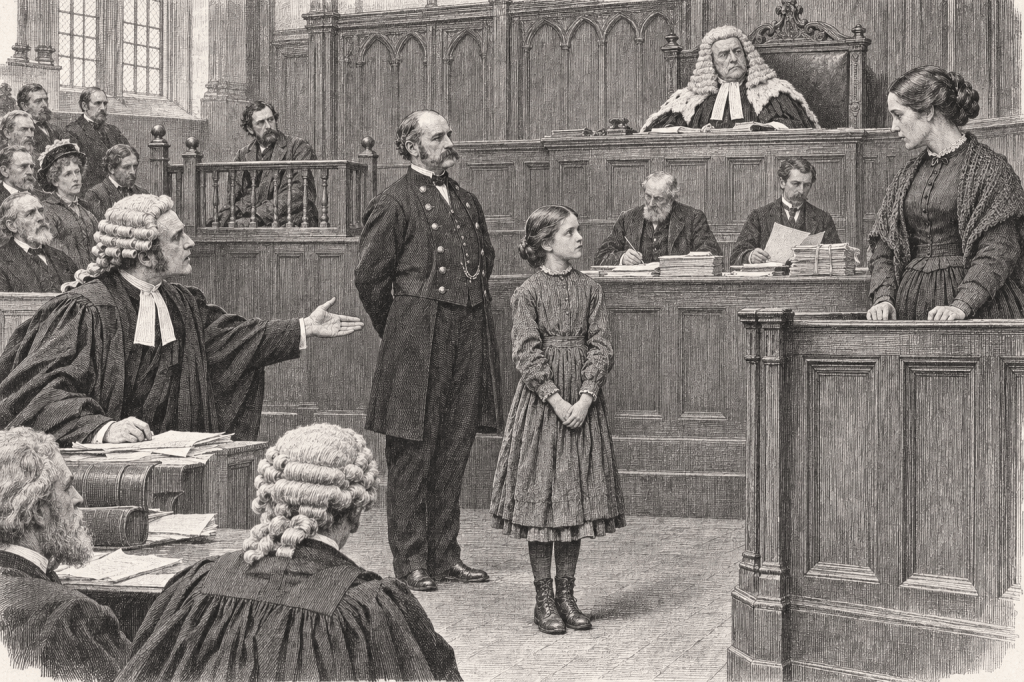
The transcript of the trial reveals that Elizabeth Hutton had been employed by Catherine Dyson to carry messages. In particular, she carried receipts relating to pictures between Catherine and Peace and may also have conveyed other communications between them. Her involvement appears to have been at Catherine’s instruction, rather than arising from any independent association with Peace.
The episode is an unusual one in Elizabeth’s otherwise relatively obscure life. It places a child from a Mosborough family within the circle of people whose activities were scrutinised during one of the most notorious murder trials of Victorian Sheffield. The newspaper reports of February 1879, including those appearing in the London Morning Advertiser, provide an important contemporary record of her involvement.
After the trial, Elizabeth returned to the family home and continued to live with her parents. Following 1879, the family were residing at Tinsley Park Wood, Sheffield, where Elizabeth spent the remainder of her unmarried years.
On 27th October 1887, at Christ Church, Attercliffe, Sheffield, Elizabeth married James Thomas Portmore Morris (1855–1923), who had been born at Ilkeston, Derbyshire. The marriage marked the beginning of a new chapter in her life, away from the family associations of Mosborough and Hackenthorpe.
By the time of the 1891 Census, Elizabeth and her husband were living at 33 Brough Low Lane, Attercliffe, together with James’s mother, Harriet. Elizabeth was then employed as a dressmaker, a skilled occupation which she evidently pursued during the early years of her married life.
Ten years later, the couple were living at 5 Peacock Row, Shepcote Lane, Tinsley, Sheffield, according to the 1901 Census. They remained in the Sheffield area, where Elizabeth continued her married life until her death.
Elizabeth died in Sheffield on 24th November 1939 and was buried at Tinsley Park Cemetery. She had lived through a period of considerable change in Sheffield and its surrounding villages, from the days when the local sickle-making industry remained an important part of the district’s economy to the very different industrial and urban landscape of the early twentieth century.
Her life is perhaps best remembered for that brief and rather remarkable episode in 1879, when, as a young girl of a well-established Mosborough family, she found herself acting as a messenger in the affairs of Charles Peace and Catherine Dyson. It is a small but intriguing footnote to the history of one of the most notorious criminal cases of the Victorian age, and an unusual link between the family history of Mosborough and the wider history of Sheffield.